This article contains affiliate links. When you book through these links, Wandopia earns a small commission at no extra cost to you. This helps us keep creating free travel guides for solo travelers. Learn more about our affiliate policy.
Introduction
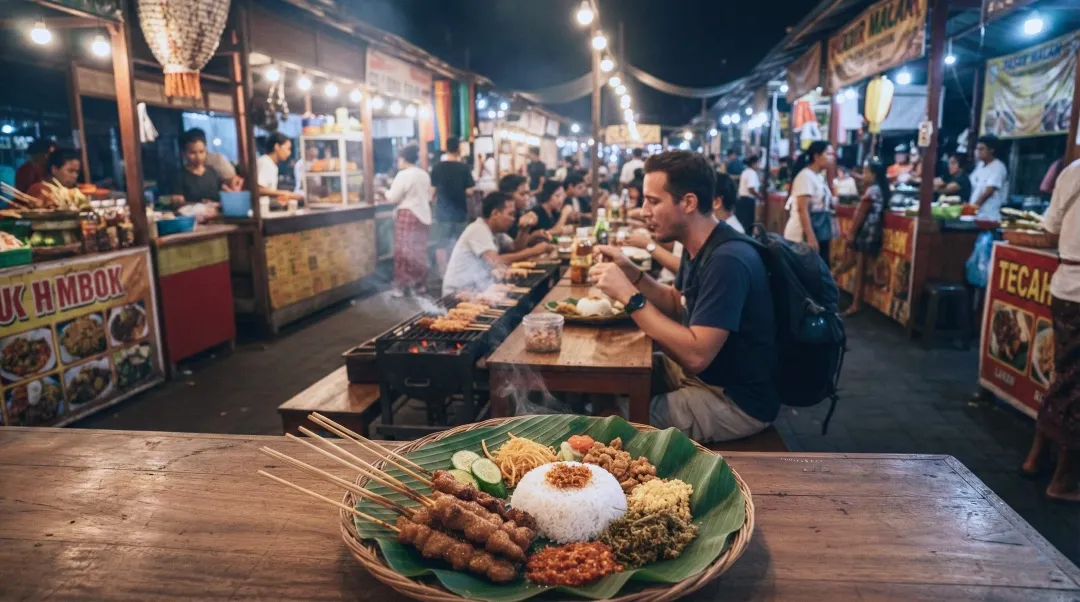
The aroma of char-grilled chicken sate and the rhythmic clack-clack of a wok hitting a gas stove define the Balinese evening. According to local tourism figures, Bali welcomed over 7 million international visitors in 2025, yet many never venture beyond the air-conditioned confines of tourist cafes.
For the solo “flashpacker,” Bali’s night markets (Pasar Malam) are not just about a cheap meal—they are the epicenter of what we’re calling “Shelf Discovery” in 2026: seeking out authentic flavors exactly where the locals find them. As a solo traveler with Indonesian roots, I’ve spent countless evenings navigating these vibrant hubs, and I can tell you that the communal tables of a Sanur night market are where the true heart of Bali beats.
In this guide, you’ll learn:
- The “Unspoken Rules” of warung etiquette for soloists
- Which markets offer the safest, most social experiences
- A 2026 budget breakdown for the savvy diner
- How to decode mystery menus without speaking fluent Bahasa
Find the best local food tours in Bali →
Why Night Markets are the Soloist’s Secret Weapon
Solo dining in a formal restaurant can sometimes feel isolating, but at a night market, the social architecture is built for connection.
The Social Flow
- Communal Seating: Most markets feature long, shared benches. It is perfectly normal (and expected) to grab an empty spot next to a local family or a fellow traveler.
- Micro-Interactions: You aren’t just a customer; you’re observing a performance. Watching a vendor flip Martabak is a great conversation starter.
- The “Inner Work” of Travel: Markets encourage a “Slo-Mo” pace. There’s no pressure to finish your meal quickly to free up a table for a party of four.
Top Markets for Solo Travelers in 2026
1. Sanur Night Market (Pasar Malam Sindhu)
The Vibe: Clean, approachable, and legendary among the “Hushpitality” crowd seeking a quieter alternative to the south. Best for: First-timers who want a safe but authentic introduction.
According to 2026 field data, prices here remain remarkably stable. A portion of Nasi Campur (mixed rice) typically costs between IDR 15,000 and IDR 30,000 ($0.90 - $1.80 USD).
- Must-Try: Sate Lilit (minced fish satay) with a side of Plecing Kangkung (spicy water spinach).
- Pro Tip: Arrive by 6:30 PM to avoid the heaviest rush but still catch the full “Pasar” energy.
2. Ubud Night Market (Pasar Gianyar)
The Vibe: Cultural, aromatic, and deeply traditional. Best for: The true foodie looking for dishes beyond the standard Nasi Goreng.
Located just a short drive from central Ubud, this is where the “Shelf Discovery” trend really shines. You’ll find vendors selling traditional snacks like Dadar Gulung (green coconut crepes) starting at just IDR 3,000 ($0.18 USD).
Where to Stay for the Best Foodie Access
For the best market access, staying in Ubud or Sanur is essential. Sanur offers a more relaxed, walkable vibe, while Ubud is the gateway to the highland coffee culture.
Find solo-friendly accommodation in Bali:
Decoding the Warung: Insider Etiquette
As an Indonesian traveler, I often see soloists hesitate at the entrance of a busy warung. Here are the “local secrets” to dining with confidence:
- The Order Flow: In most markets, you order at the stall and then find a seat. At a Nasi Campur stall, you simply point at what looks good.
- Payment Protocol (Cash & QRIS): While cash is still king, QRIS (Quick Response Code Indonesian Standard) is now accepted even at small street stalls.
- For Tourists: If you are from Singapore, Malaysia, Thailand, or Japan, you can likely scan QRIS directly with your home bank app.
- The GoPay/Grab Hack: If your home app doesn’t work, download Gojek or Grab. You can top up GoPay with cash at any Alfamart or Indomaret convenience store. Simply scan the vendor’s QRIS code with the app—it’s fast, secure, and saves you from carrying heavy coins.
- Timing: Usually, you pay after you eat. catch the vendor’s eye and say “Minta bon” (the bill) or simply point to your empty plate and hold up your phone or wallet.
- The Water Rule: Stick to bottled water (Aqua) or try a Teh Botol (sweetened jasmine tea). In 2026, most markets use ice made from purified water, but it’s always safer to ask for “no ice” (tanpa es) if you have a sensitive stomach.
Getting There and Planning
Most solo travelers find that using a private driver or a ride-hailing app like Gojek/Grab is the safest way to navigate the traffic between markets.
Compare flight prices to Denpasar (DPS):
2026 Solo Dining Budget Breakdown
| Item | IDR (Approx) | USD (Approx) |
|---|---|---|
| Street Snack (Gorengan) | 5,000 - 10,000 | $0.30 - $0.60 |
| Main Dish (Nasi Campur) | 20,000 - 45,000 | $1.20 - $2.70 |
| Fresh Tropical Juice | 15,000 - 25,000 | $0.90 - $1.50 |
| Total Full Meal | 40,000 - 80,000 | $2.40 - $4.80 |
Conclusion
Solo dining at Bali’s night markets is more than a budget strategy; it’s a bridge to understanding the island’s natural rhythm. By embracing the “Shelf Discovery” mindset, you move from being a spectator to a participant in Balinese daily life.
Ready to start your culinary adventure?
- Start at Pasar Sindhu in Sanur for an easy win.
- Bring small bills (IDR 2,000, 5,000, and 10,000 notes).
- Smile, point, and don’t be afraid of the sambal!
Book a guided Bali night market tour →
Have you braved a Bali night market solo? What was your favorite discovery? Share your “Shelf Discovery” stories in the comments below!